
COA
Certificate of Analysis
Third-party HPLC and MS testing for every batch, published before purchase and tied to the batch being sold.
HPLC / MSAll products made available on this website are intended exclusively for research and development purposes and are strictly not for human consumption or therapeutic use. These products are not approved by the U.S. Food and Drug Administration (FDA), and no statements on this website have been evaluated by the FDA.
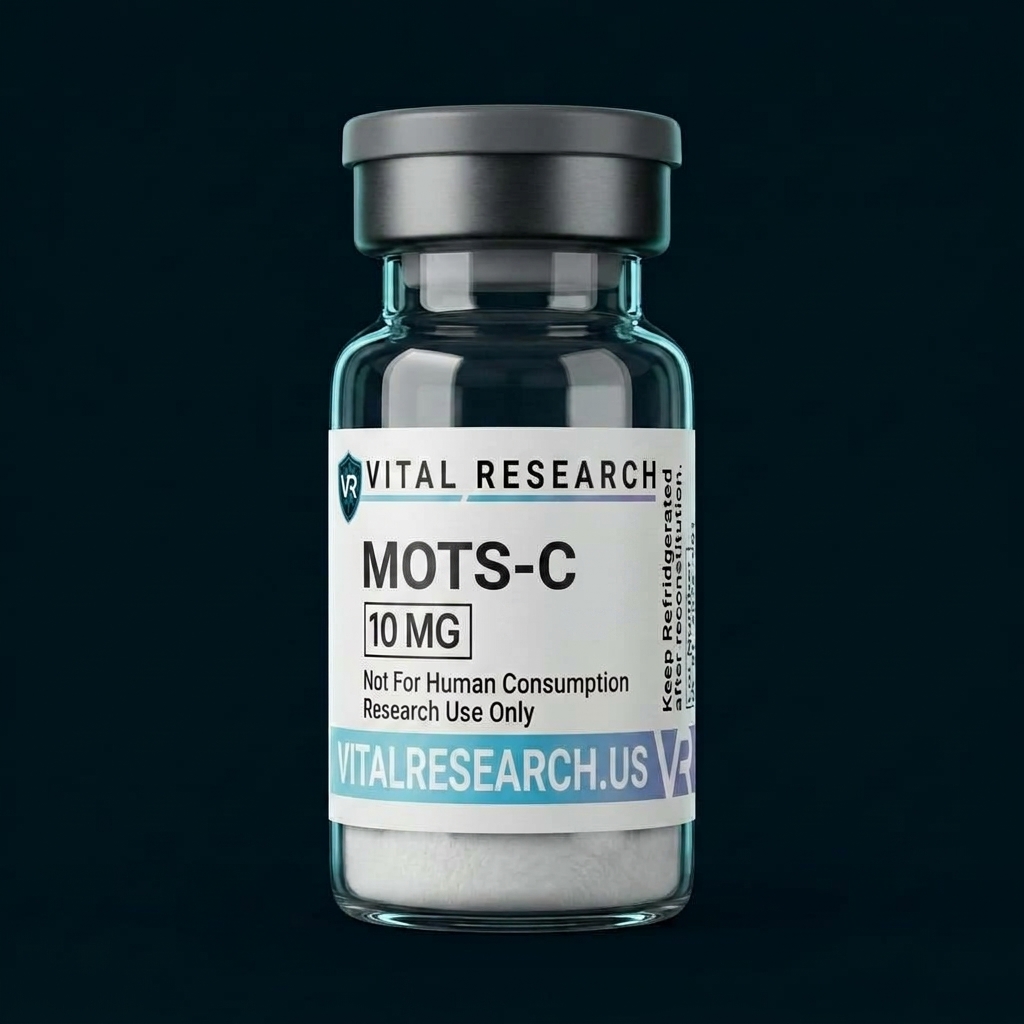
Mitochondrial-derived peptide for metabolic research.
Lyophilized powder may shift or come loose during transit; that is a normal occurrence and does not affect the integrity of the research product. Fill appearance and batch-specific details may vary. Refer to the Certificate of Analysis below for the documentation tied to the current batch.
MOTS-c is studied because it connects to mitochondria, the part of the cell best known for energy production. More specifically, researchers look at MOTS-c as a signaling peptide: a small peptide that may help explain how mitochondria communicate with the rest of the cell.
The research is mostly about cellular stress, energy-related pathways, and metabolic model systems. In simple terms, MOTS-c is interesting because it sits at the intersection of mitochondria, cell signaling, and energy-related biology.
Third-party HPLC and MS testing for every batch, published before purchase and tied to the batch being sold.
HPLC / MSEvery vial is stamped with a batch ID that links back to its COA, source record, and current product documentation.
Batch linkedProduct identity, strength, and batch reference stay easy to match from the product listing to the vial in hand.
Listing to vialMOTS-c is discussed as a mitochondrial-derived peptide encoded from the mitochondrial 12S rRNA region. That gives it a different research story than peptides built mainly around surface-receptor agonism.
AMPK is often described as a cellular energy sensor. In MOTS-c literature, AMPK-linked signaling is one of the main ways researchers discuss stress response, fuel handling, and energy-related cell behavior.
Some MOTS-c research looks at how mitochondrial stress signals can connect back to nuclear gene-expression programs. That is the interesting part: mitochondria are not just power plants; they also send signals.
MOTS-c is the mitochondrial-derived signaling lane. SS-31 is the mitochondria-targeted membrane lane, centered more around cardiolipin and inner-membrane bioenergetics.
Literature links are included for background reading. Batch-specific identity and purity details live in the COA tied to the current batch.